
For Police — Prevention+
Turning NPCC strategy into operational impact with Prevention+.
Helping forces prevent harm, reduce demand and make every intervention count.
Why Prevention+
Prevention is a core policing priority.
The challenge for forces is not whether prevention matters, but how to turn the NPCC prevention strategy into day-to-day operational practice.
Prevention+ helps police forces and partners identify risk earlier, coordinate activity around people and places, and evidence the impact of preventative work. Provides a single, practical platform to support problem solving, early intervention, offender diversion, victim support and demand reduction.
Supporting the NPCC's national policing prevention strategy
Fewer victims. Fewer offences. Less demand. Greater efficiency.
Prevention+ helps forces implement a proactive, evidence-led prevention and demand management approach. It supports four key outcomes:
Cultural change
Embed prevention as a core policing function. Make preventative activity visible, structured and accountable — part of everyday policing, not an extra task.
Reduced harm
Earlier identification of vulnerability, repeat victimisation and emerging risk. Coordinate activity around individuals, families, cohorts, places and communities before risk escalates.
Reduced offending
Understand the causes, opportunities and patterns behind offending. Support diversion, rehabilitation and targeted intervention before behaviour escalates.
Reduced demand
Visibility of risk, activity, ownership and outcomes. A systematic, cost-effective approach to problem solving that focuses resources where they have the greatest impact.
From strategy to delivery
Built for the three levels of the NPCC prevention strategy.
Reducing risk across communities
Identify common drivers of harm and demand across populations and places. Support public-health-style approaches, early education, community engagement and targeted campaigns.
Intervening earlier with people at risk
Identify individuals, families or cohorts at higher risk of harm, victimisation or offending. Coordinate early intervention, diversion pathways, referrals and partner activity.
Reducing recurrence and repeat demand
Work with repeat victims, repeat locations and repeat offenders. Allocate ownership, manage interventions and evaluate whether activity is reducing harm and future demand.
Evidence-based problem solving
Understand. Own. Intervene. Evaluate.
- Prioritise people, places and problems linked to threat, risk, harm and vulnerability
- Understand patterns, drivers and repeat demand
- Enable defensible decision making and address disproportionality concerns
- Allocate clear ownership and accountability at agency and individual level
- Coordinate multi-agency interventions
- Track actions, referrals, outcomes and follow-up activity
- Evaluate impact and capture learning
- Build an evidence base for what works locally
- Support commissioning decisions
A shared view of risk and activity for prevention teams, neighbourhood policing, offender management, ASB teams, youth justice, violence reduction and community safety partnerships.
Built for partnership working
From fragmented information sharing to coordinated prevention.
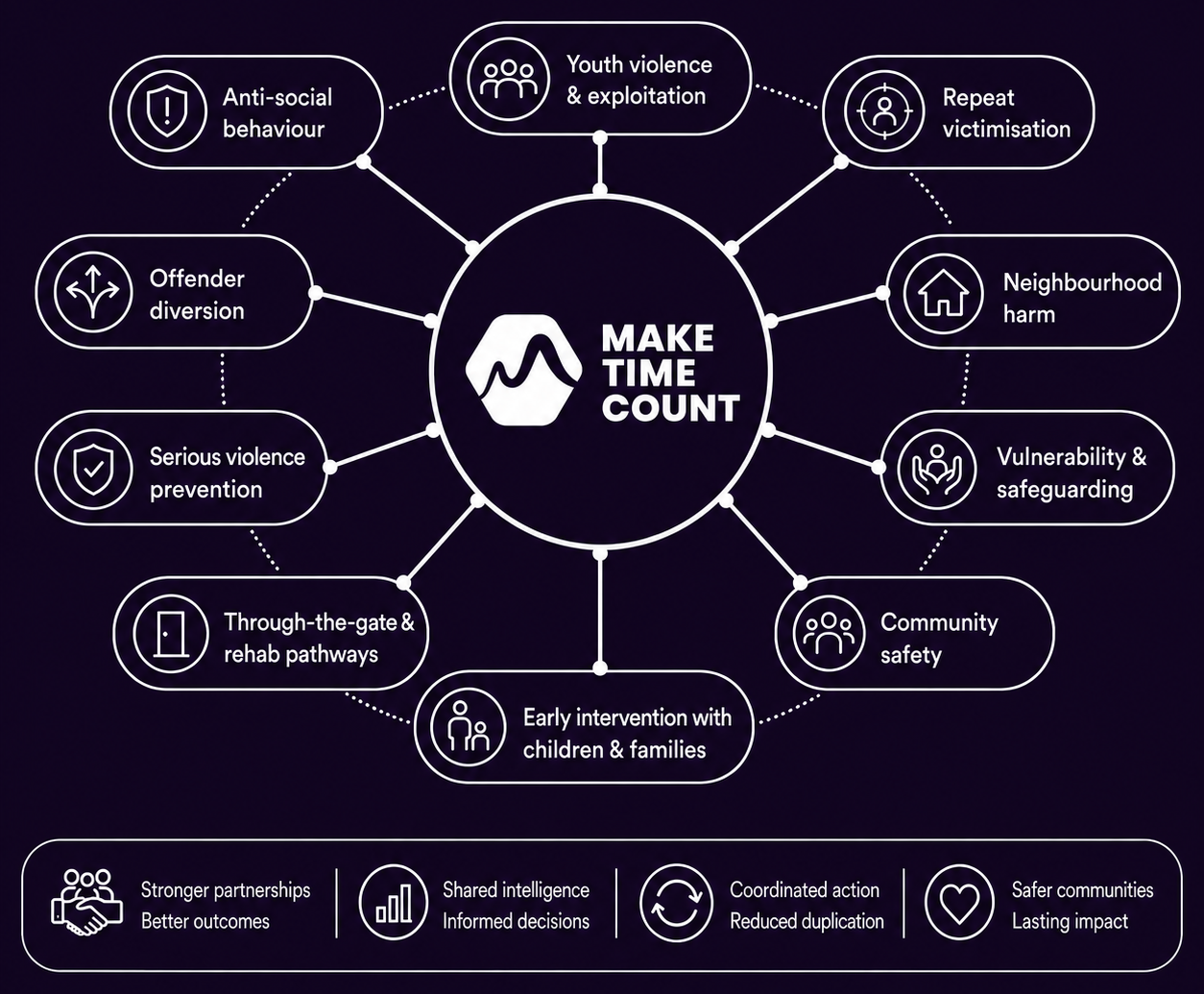
Better information. Better decisions. Better outcomes.
What Prevention+ supports.
Consistent decision making
The right outcome every time via a consistent and transparent eligibility screening process. Addresses disproportionality concerns and provides visibility of officer rationale.
Criminogenic needs assessment
Identifies the drivers of offending behaviour. Assessments can be shared and co-authored with referral partners, avoiding duplication and reducing the risk of re-traumatisation.
Recommendation engine
Options for conditions and referral pathways recommended based on user, offence and need — taking the guesswork out of referrals.
Partner coordination
Accommodates statutory and commissioned services, voluntary sector and informal community networks. Enables police and partners to work from one system — a shared view of responsibilities, activity, actions and outcomes.
Outcome tracking
Capture impact: reduced repeat demand, improved engagement, diversion outcomes and reduced harm.
Real-time feedback
Check-in to provide attendance tracking in real time. Feedback from and about the user captured from every interaction.
Case & referral management
Manage people and places through structured prevention pathways with clear ownership and follow-up.
Problem-solving scrutiny & governance
Support local, regional and strategic prevention and scrutiny boards with better data on risk, demand, interventions and progress.
Learning & continuous improvement
Understand what is working, where the gaps remain and how prevention activity can be strengthened over time.
Prevention+ in practice
One platform. Every prevention use case.
Out of Court Resolution
Evidence-based process — the only end-to-end solution available on the market. Make the right decision, understand and make the appropriate referral and track to completion, or manage breach.
Deferred Prosecution
Establish and deliver a deferred prosecution programme — ensuring users are correctly referred and complete all agreed actions, or manage breach.
General offender management
Support diversion, rehabilitation and desistance with better visibility of needs, risks, interventions and outcomes.
Integrated Offender Management
Finally, a truly integrated platform to bring all agencies and local support networks together to address the most frequent reoffenders.
Neighbourhood policing
Manage problem locations, recurring community issues and people causing or experiencing harm. Coordinate local partners and track whether interventions reduce demand.
Anti-social behaviour
Manage ASB caseload, support vulnerable complainants and target repeat perpetrators. Coordinate community safety partners on one shared system.
Youth prevention & diversion
Support children and young people at risk of offending, exploitation or harm. Coordinate early help, youth justice, education, family support and the voluntary sector.
Violence reduction
Cohort management, risk assessment, partner referrals and intervention tracking for individuals and locations linked to serious violence.
Victim support
Identify repeat victims, vulnerable victims and safeguarding concerns — ensuring the right support is coordinated and followed up.
And more…
We can tailor case management and workflow for almost any scenario where multi-agency collaboration is required.
Prevention Command
A shared view of risk, action and impact.
Move beyond recording activity. Prevention Command gives leaders and practitioners a single view across teams, cohorts and partnerships — and helps answer the questions that matter:
Home Office recognised
The only end-to-end
Out of Court Resolution
solution for policing.
A Home Office–funded ACE (Accelerated Capability Environment) commission reviewed the digital tools available to support Out of Court Resolutions across UK forces. Solutions were grouped into decision-support tools, modular point solutions and case management platforms — varying widely in maturity, scalability and readiness for national adoption.
Make Time Count was highlighted as the only end-to-end solution covering the full OoCR journey — built, tested and deployed in collaboration with partner forces and already supporting thousands of users across the UK.
OoCR Tool Assessment — Solutions Directory
| Capability | Co1 | Co2 | Co3 | Co4 |  | Co6 | Co7 | Co8 | Co9 | Co10 |
|---|---|---|---|---|---|---|---|---|---|---|
| Eligibility screening | ✕ | ✕ | ✕ | ✕ | ✕ | ✕ | ||||
| Offender needs assessment | ✕ | ✕ | ✕ | ✕ | – | ✕ | ✕ | |||
| Prescribing conditions | – | ✕ | ✕ | ✕ | ✕ | ✕ | ✕ | ✕ | ✕ | |
| Officer guidance | – | ✕ | ✕ | ✕ | ||||||
| Recording case details | ✕ | ✕ | ✕ | |||||||
| Document creation | ✕ | ✕ | ✕ | – | – | |||||
| Workflow & tasks | ✕ | ✕ | ✕ | – | ✕ | ✕ | ||||
| Third-party referrals | ✕ | ✕ | ✕ | ✕ | – | ✕ | ||||
| Oversight & compliance | ✕ | ✕ | ✕ | ✕ | – | |||||
| Analytics & reporting | ✕ | ✕ | – | – | – | ✕ | ||||
| RMS integration | ✕ | ✕ | ✕ | ✕ | ✕ | ✕ | – | ✕ |
Co1–Co10 represent the other suppliers assessed. Make Time Count was the only platform delivering all eleven OoCR functions end-to-end.
The savings
Diverting from court delivers £2.85m per 1,000 cases.
Recommending a diversionary outcome for 1,000 low-level cases — informed by Project Fulcrum and Cambridge University research — releases significant police and wider CJ savings, while improving detection and victim satisfaction.
Total CJ savings
£2.85m
Across police, CPS, legal aid and courts.
Police savings
£1.17m
Includes a 15% breach rate back to court.
Hours released
23,913
45,500 court hrs vs 21,587 OoCR hrs.
Capacity unlocked
15
Officers redeployable + 4 FTE staff freed.
Why forces choose Make Time Count
Not just case management. A prevention command capability for modern policing.
We turn complex multi-agency work into clear, manageable and measurable activity.
- Align local delivery to the National Policing Prevention Strategy
- Reduce avoidable demand by tackling root causes earlier
- Improve partnership working around people, places and problems
- Evidence the value of prevention activity
- Support problem-solving across operational and strategic teams
- Make better use of intelligence, data and digital workflows
- Create a clearer line of sight from intervention to outcome
Make Time Count with Prevention+
Ready to strengthen your prevention capability?
Speak to Make Time Count about how Prevention+ can support your force's prevention strategy, partnership model and operational delivery.